

Moving Through the Monotony: How Dance Movement Therapy Reshapes Chronic Pain
When you live with chronic pain, your relationship with your body can feel like a constant battle. Pain isn't just a physical sensation; it changes how you move, how you breathe, and how you perceive yourself. Over time, fear of pain can cause you to guard your movements, leading to stiffness, muscle tension, and a shrinking world.
If traditional exercise feels too rigid or intimidating, Dance Movement Therapy (DMT) offers a different path. It is an integrative approach that treats movement not as a chore or a strict routine, but as a bridge to healing.
What is Dance Movement Therapy?
Dance Movement Therapy is the psychotherapeutic use of movement to promote emotional, social, cognitive, and physical integration. It is led by a qualified registered professional (a registered dance movement therapist) who helps you explore your inner state through physical expression.
The Golden Rule of DMT: You do not need to be a "dancer" to practice this. There are no steps to memorise, no mirrors to judge yourself, and no right or wrong way to move. If you can breathe, twitch a finger, or rock back and forth, you can participate.
The Science: Rewiring the Pain Pathways
To understand why DMT works, it helps to look at how chronic pain operates in the brain. Chronic pain often acts like a faulty alarm alerting for threat (injury), even after the threat has passed / the injury has healed. This is because the nervous system remains stuck in a state of high alert, continuously sending pain signals through the spinal cord up to the brain.
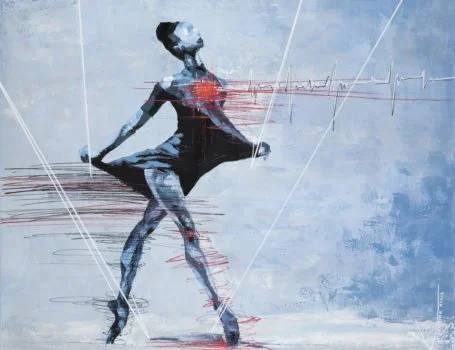
‘Dance through pain’ image by Kristina Mygul https://kristinamygul.art/gallery/dance-through-pain/
When you engage in creative, expressive movement, you introduce new sensory inputs into this feedback loop. DMT helps rewire these pathways in three specific ways:
Calming the Amygdala: The amygdala processes fear and emotional responses to pain. Gentle, rhythmic movement signals safety to the brain, dialing down the flight-or-fight response.
Reclaiming the Somatosensory Cortex: Chronic pain can blur the brain's "map" of the body, making parts of you feel entirely dissociated or purely painful. Creative movement helps redraw this map with positive, non-pain sensations.
Releasing Endorphins: Moving to music triggers the release of endorphins and dopamine—the body's natural painkillers and mood lifters.
How DMT Differs from Standard Physical Therapy
While physical therapy is incredibly valuable for structural rehabilitation, DMT targets the emotional and psychological layers that always accompany long-term pain.
Physical Therapy:
Focus: Biomechanics, strength, and targeted flexibility
Structure: Prescribed repetitions and specific alignment goals.
Pain management: Works through or around structural limitations.
Dance Movement Therapy
Focus: Mind-body connection, emotional expression, and autonomy.
Structure: Spontaneous, improvised, or guided exploratory movement.
Pain Management: Addresses the emotional anxiety and fear associated with moving.
What a Typical Session Looks Like
If you walk into a DMT group or individual session, you won’t see a typical dance class format. Instead, a session usually follows a gentle, structured progression:
The Check-In: The first 10 minutes might start with talking and some moving. I will invite you to share how you are feeling and how you’ve arrived. This will be a chance to check in with me and with yourself on how you are doing mentally, emotionally, and physically. I may draw attention to how you are feeling in your body, including any pain, tension or any inner sensations you notice. Sometimes we represent this with a movement, gesture or sound. For example, if you feel tired and heavy your movement might simply be a slow drop of the shoulders.
Warm-Up: The next 10 minutes we will warm up the body bringing awareness to breath and body parts and slowly expanding your range of motion at your own pace. There is no correct movement we go with whatever tempo, energy, and movement the body needs. Sometimes the awareness to our body and movement brings awareness of tensions or feelings we hadnt given attention to.
The main session: This is where we expand the session, moving together and exploring different topics. Initial sessions will likely include a lot of mirroring - where we lead one another through movement. I might prompt creative exploration for example, "Imagine moving through water," or "Explore the space around you using only your left side." This encourages you to find paths of movement that feel safe and fluid, and helps you notice using your body what feels comfortable, where you feel resistance, or what is not tolerable. Usually feelings or memories may emerge through this process and we can process that in different ways - talking, moving, or sometimes even art-making.
Closure: The session ends with grounding movements and a verbal reflection to integrate what you felt physically with what you experienced emotionally.
Gentle Ways to Explore Expressive Movement At Home
If you want to start exploring the principles of movement therapy on your own, try these micro-practices:
The Micro-Dance: Put on a song that you love. Sit or lie down comfortably. Close your eyes and try moving only your fingers, hands, or wrists to the rhythm. Notice how it feels to let a single body part express the music.
Breath Mirroring: Place one hand on your chest and one on your belly. Breathe in deeply and let your hands rise and fall. Slowly let that natural breathing rhythm dictate a gentle sway in your spine.
Tension Tracking: If a specific area hurts, don't try to force it to stretch. Instead, look at it, acknowledge it, and gently move the joints around it (like circling your wrists if your shoulder hurts) to remind your nervous system that movement can still be safe.
Chronic pain tries to convince you that your body is an enemy territory. Dance Movement Therapy gives you a gentle, creative language to negotiate a peace treaty with yourself—one small movement at any given time.